POM vs Nylon for Precision Molded Parts: How to Avoid Dimensional Drift
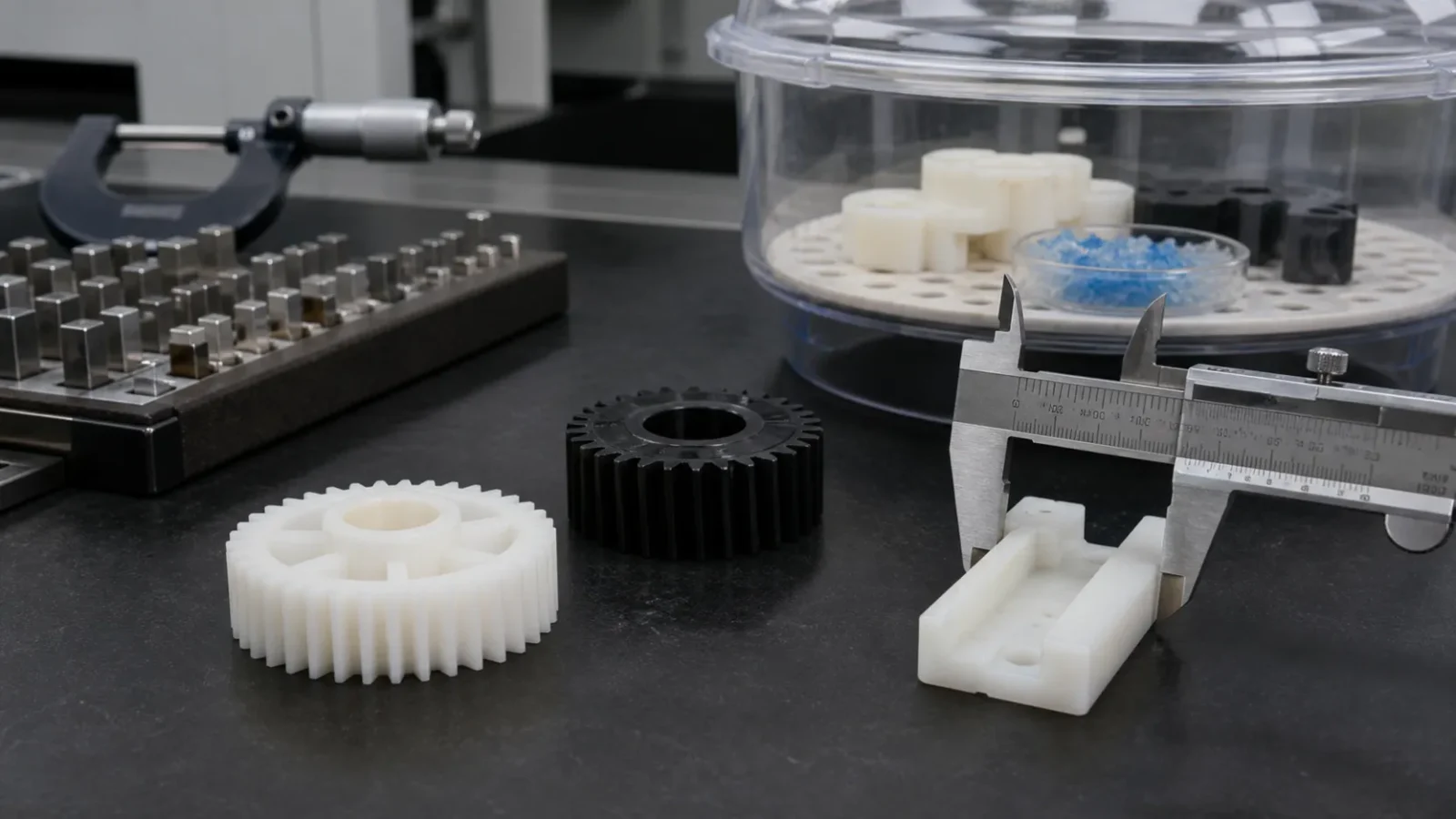
POM vs nylon for gears, clips, and sliding parts: compare moisture absorption, stiffness change, wear, and processing to prevent dimensional drift.
The short answer
1. Moisture is the biggest dividing line
2. Why moisture becomes a tolerance problem
- Hole diameter and center-to-center distance.
- Tooth engagement in gears.
- Snap-fit force and clip retention.
- Flatness in thin parts.
- Stiffness and creep response.
- Assembly force with metal inserts or mating plastics.
3. Compare dry and conditioned properties before choosing nylon
4. Friction and wear: define the actual contact condition
- Mating material and surface finish.
- Contact pressure and sliding speed.
- Temperature rise at the contact point.
- Lubrication, contamination, and moisture.
- Geometry, alignment, and cycle count.
- Fillers, lubricants, and reinforcement in the selected grade.
5. Processing discipline matters for both materials
6. A decision table for buyers and engineers
7. Build a validation plan before the first production order
- Define the service condition.State humidity, immersion, temperature range, chemicals, load, and cycle count.
- Set the conditioning state.Measure critical dimensions as molded, after a controlled humidity condition, and after the relevant immersion or aging exposure.
- Use the same test language.ASTM D570 and ISO 62 both address water absorption, but methods and specimens can differ. Record the exact method and condition.
- Measure functional dimensions.Check tooth backlash, insertion force, sealing surface, snap retention, or sliding force—not only a length coupon.
- Request lot traceability.Keep the grade name, supplier documentation, processing record, and retained samples linked to the approval.
POM vs nylon: the practical conclusion
FAQ
Is POM more dimensionally stable than nylon?
Can nylon be used for precision parts?
Is POM always better for gears?
Technical data note
Sources for the technical examples
- Delrin® design guide, including 100P water absorption and friction data
- BASF Ultramid® B3K product data