
Polycarbonate Grade Selection: MFR, Viscosity, Datasheet
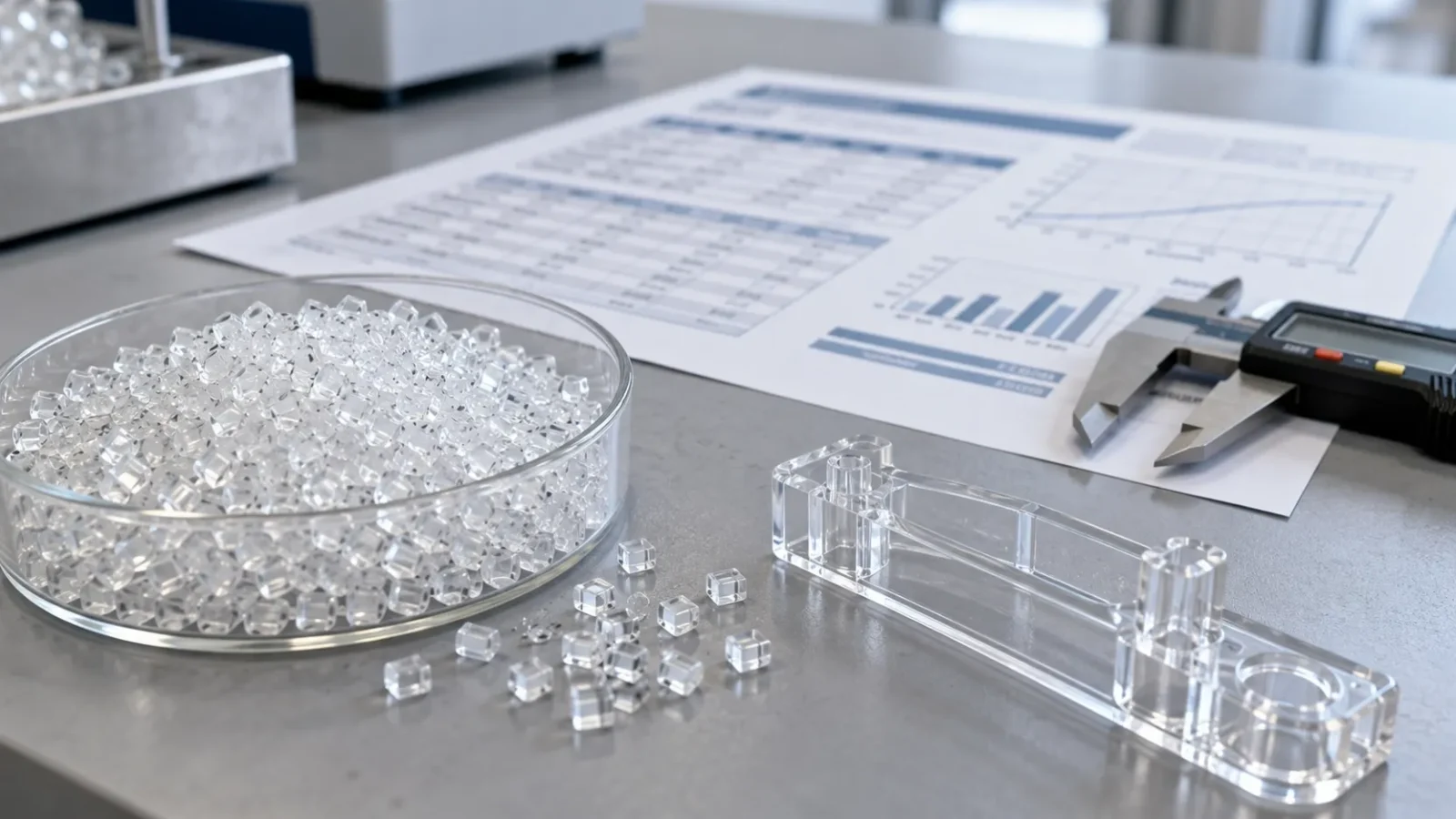
How to read a PC datasheet: MFR and viscosity windows, the seven fields that matter, compliance documents and batch-to-batch drift.
What MFR Actually Tells You About a Polycarbonate Grade
MFR vs. MVR: Which Number Is on Your Datasheet?
Why Viscosity Does Not Equal MFR
Three Properties You Should Always Compare With MFR
- Density — ISO 1183 or ASTM D792:Confirms that you are comparing the same material family and using appropriate feeding and weight assumptions.
- Notched impact strength — ISO 179 Charpy or ISO 180 Izod:Shows whether the required toughness is maintained after changing grades. The test method and notch type must be stated.
- Heat deflection temperature — ISO 75 or ASTM D648:Indicates whether the molded component can retain its shape at the required service temperature. Results measured at 0.45 MPa and 1.82 MPa are different and must not be compared as if they were the same.
Medium vs. Low Viscosity: Matching the Grade to the Part
Thin-Wall and Long-Flow Parts
- Thin-wall components
- Long flow paths
- Complex molded geometry
- Multi-cavity tools
- Components that would otherwise require excessive injection pressure
- Parts that cannot tolerate an unnecessarily high melt temperature
Thick Sections and Optical Parts
- Thick molded sections
- Parts with varying wall thickness
- Structural components
- Transparent components
- Optical parts that require controlled internal stress
- Parts that are sensitive to excessive shear
Evaluating WY-111BR
A Simple Part-to-Grade Mapping Table
Seven Fields to Check on Every Polycarbonate Datasheet
- Full grade designation and manufacturerA trade name or abbreviated family name is not enough. Confirm the complete grade designation and the legal manufacturer.
- MFR or MVR with complete test conditionsThe datasheet should identify the test standard, temperature and applied load.
- Density with test methodDensity should be reported with an ISO or ASTM method.
- Notched impact strengthConfirm the test method, specimen type, notch type and test temperature.
- Heat deflection temperatureThe applied load must be stated. Values measured at 0.45 MPa and 1.82 MPa are not interchangeable.
- Optical propertiesFor transparent components, review total luminous transmittance and haze according to ASTM D1003 or the applicable ISO equivalent.
- Yellow indexYellow index helps indicate whether an optical or appearance-critical component may show color variation or change over time.
Why Test Methods Matter More Than Headline Values
- Which test method was used
- What specimen geometry was tested
- What test speed was used
- What conditioning procedure was applied
- Whether the result is typical or guaranteed
Where to Cross-Check an Unfamiliar Grade
- UL Prospector
- MatWeb
- UL Product iQ for applicable UL recognition information
How to Read a Translated Chinese Supplier Datasheet
- “Melt index” translated without the test temperature and load
- Mechanical properties converted between MPa, kg/cm² or psi without a stated test method
- “Heat resistance” reported as a single temperature without a load or testing standard
- Compliance claims reduced to a statement such as “meets FDA” without naming the applicable regulation
- Missing distinction between typical values and guaranteed specifications
- Different grade names appearing in the title, table or document footer
Food-Contact and UL Compliance: What Buyers Should Request
Food-Contact Documentation
- The exact material grade
- The applicable regulation
- The intended conditions of use
- Any relevant limitations
- Supporting migration data when required
- The document date and revision
UL Yellow Card Coverage
- Exact grade designation
- Color
- Minimum tested thickness
- Flame classification
- Electrical properties
- Manufacturer and production location
RoHS and REACH SVHC Statements
Batch-to-Batch Color and Clarity
Why Yellow Index Can Drift
- Base-polymer variation
- Additive variation
- Color formulation differences
- Regrind content
- Lot-to-lot material variation
- Excessive melt temperature
- Long residence time
- Insufficient drying
- Material remaining in the barrel during production stops
- Contamination from a previous material or color
- Different machine conditions
Drying Before Molding
- Silver streaks
- Haze
- Bubbles
- Surface defects
- Reduced impact strength
- Polymer degradation
Incoming Inspection for Optical or Appearance-Critical Parts
- Yellow index
- Haze
- Light transmittance
- Color difference
- Pellet appearance
- Batch number
- COA review
- Packaging condition
Substitution Limits: When a Similar PC Grade Is Not Equivalent
Equivalent MFR, Different Molecular Weight Distribution
- Reduced low-temperature impact strength
- Stress cracking
- Warpage
- Different packing behavior
- Increased internal stress
- Changes in surface appearance
- Unstable cycle time
Optical Parts Are the Hardest to Substitute
Qualification Checklist Before Approving a Substitute
Checks That Can Be Completed on the Production Site
- Part weight
- Critical dimensions
- Appearance compared with the approved sample
- Cycle time
- Filling behavior
- Molding defects
- Color match under the standard light source
- Ejection and mold-release behavior
- Assembly performance
Checks That May Require Laboratory Testing
- Notched impact strength
- Heat deflection temperature
- Light transmittance
- Haze
- Yellow index
- Tensile properties
- Flexural properties
- Application-specific chemical resistance
- Food-contact migration
- Flame classification or other regulatory requirements
When We Would Advise Against Changing Grades
- An optical part is already covered by an approved customer specification
- The replacement is not covered by the required UL recognition
- A food-contact application lacks matching compliance documents
- The component performs a safety-critical function
- The existing approval process would cost more than the expected material saving
- The replacement cannot be tested using the actual production mold
- The supplier cannot provide complete and current documentation
Frequently Asked Questions
Can two polycarbonate grades with the same MFR be treated as equivalent?
Is MFR the same as viscosity?
What information must accompany an MFR value?
Which properties matter most for transparent polycarbonate parts?
What food-contact documents should a buyer request?
Does a UL Yellow Card cover every color and thickness?
What documents should accompany each polycarbonate shipment?
When should a polycarbonate grade not be substituted?
Need Help Reviewing a Polycarbonate Datasheet?
- Missing test conditions
- Properties that cannot be compared directly
- Required compliance documents
- Potential substitution risks
- Information that should be confirmed on the batch COA